B2B Trade Show ROI. What to Budget and How to Measure Results.
I spent four days at PACK EXPO International in Chicago this October with two clients on the floor. One was a European company making its first appearance in the US market from a 10 by 10 booth. The other was a longtime client that has exhibited at the Chicago show for years. Both were asking a version of the same question. Is this worth it? The answer was yes for both of them, for different reasons, and the difference is the most useful thing I can pass along.
Why trade shows still earn a place in the budget
In packaging, manufacturing and energy, the product is physical. A machine runs or it does not. A fiber tray formed without process water either holds up in your hand or it does not. I have watched plenty of 45 second product videos. None of them replaces an engineer standing at a line while it cycles, asking the question the video never answers.
A show also puts your customers, prospects, competitors, distributors and the reporters who cover your category in one building for four days. No other week on the calendar does that. PMMI reported more than 43,000 attendees and 2,700 exhibitors in Chicago this year, and the industry as a whole still puts 41 percent of its marketing budgets into trade shows, the same share as in 2017. That number does not prove any one company earned a return. It does tell you nobody has found a substitute.
Two companies, two different answers
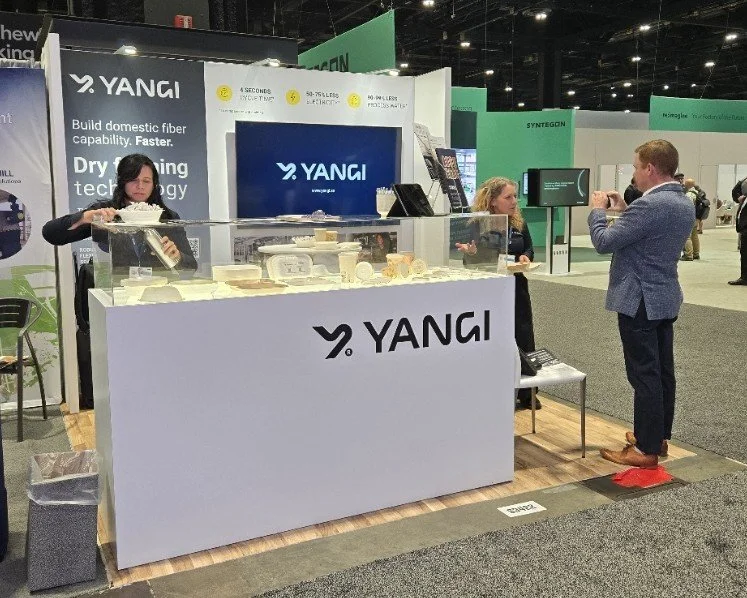
Yangi founder Anna Altner is interviewed by Matt Reynolds, chief editor of Packaging World, at the Yangi booth at PACK EXPO International 2026.
My European client had a decision to make this year. Spend the money on a first US show or wait until the sales pipeline justified it. Skipping would have been a mistake, in my opinion. A company nobody in this market has met needs to be seen in the room where its category is being discussed, with its founder on the floor answering questions. So we prepared for that. We sent reporter content kits before the show. We put a press window on the calendar, and we scheduled booth hours instead of leaving them open-ended. The booth was small. The conversations were not.
Being seen is only worth paying for if it produces something you can act on, and for a newcomer that is information you cannot get from a desk in Europe. Which US applications drew real interest. What buyers questioned first, and whether the answer was ready. What a converter or distributor wanted to understand before it would talk about a partnership. Four days on the floor answered questions that months of outbound email had not.
My longtime client exhibits at the Chicago show only and sends people to walk the regional shows without a booth. The Chicago show is the flagship and the whole industry attends. Walking a regional show costs a plane ticket and a hotel room, and for a company that already has name recognition, that is the right trade. The exception is a regional show where your specific buyers happen to concentrate. If the plant managers you need to reach are in Philadelphia in February, a smaller booth at a smaller show can be a better use of your budget.
If you take one thing from this article, take that. A company entering a market and an established exhibitor are not buying the same thing when they buy a booth, so they shouldn’t judge the show by the same standard. The newcomer is paying to be found and to learn. The established company is paying for efficient time with people it already knows, and it should be ruthless about the price of that time.
Who actually goes to packaging trade shows
Engineers and operations people from brand owners and converters. These are the people who will specify your equipment or material, and they are there to see what is new. One exhibitor told Plastics Today that about 70 percent of the visitors it engaged were new contacts. That matches what I saw.
Existing customers, who stop by to see what you have added and will tell you what is bothering them if someone is there to listen. Competitors, because everyone walks everyone's booth.
Reporters and writers. The major packaging trade titles send editorial staff, and a good share of show coverage now comes from freelance writers working across several outlets. Either way, exhibitors have to supply the context. Reporters do not take booth tours, and they do not stop by because you asked. They come when they already know there is something to see.
What trade show PR can realistically deliver
Reporters cover news. They don't cover booths, no matter how nice the carpet. The clients I have seen earn real coverage at a show had a product launch with a release out two weeks ahead, photography ready to send, a spokesperson who could answer a qualifying question without a handler and a defined window when that person would be available. None of that guarantees a story, because the reporter decides what runs. It does change the odds considerably. With that preparation in place, a few trade articles, a mention in the show roundups and a video walkthrough are reasonable to hope for. Without it, the most likely outcome is a line in the exhibitor list, and I would rather say that now than after the invoice.
Reporters show up when they show up. Publish your spokesperson’s availability, make booking optional rather than required, and count the conversations that happened.
What belongs in a trade show budget
Here is the math for the Chicago show. Space costs $34.25 per square foot and PMMI includes material handling in that rate, subject to its conditions, which most shows do not. A 10 by 10 runs $3,425 in space. A 20 by 20 runs $13,700. And after that, you still have to supply a booth.
The booth itself is usually the larger check. A simple 10 by 10 build with hard walls, printed graphics, a display case, and a high table came in under $10,000 for one of my clients this year, and that is about as lean as a professional looking booth gets. At 20 by 20, a full rental package that includes design, hardware, graphics, freight, setup and dismantle typically runs $18,000 to $30,000, and a custom build with running equipment on the floor goes well past that. Two years ago, the last time the show was in Chicago, I had another client in a 20 by 20 that paid closer to $75,000 for the booth.
The industry benchmark from CEIR is that space is about 40 percent of what exhibitors spend. I would not use that percentage alone to budget a small booth. Travel, staffing and installation can take a larger share of the total, because those costs do not shrink with the square footage. A booth still has to be designed and built or rented, shipped, installed and taken down. Two or three people still fly in and stay four nights, and they still stop doing their day jobs for a week. Someone still has to produce the release, the photography and the follow up.
So the planning ranges I use run higher than the benchmark would suggest. For a 10 by 10 done properly, plan on $15,000 to $25,000 all in. That covers space, a rented or simple custom build, travel for two or three people, their time, photography and the communications work. For a 20 by 20 with a rental booth, plan on $40,000 to $75,000. A custom build with running equipment, like the one my client did two years ago, pushes the total past $100,000 once space, travel and communications are added. Treat these as planning ranges rather than an industry figure. Your own numbers will depend on how far your team travels, what you ship and how much of the work you do in house.
Costs are moving in one direction. The Exhibitor Advocate's 2025 rate survey found material handling rates up 9.5 percent in a single year. Fewer, better shows is the trend, and I agree.
Exhibit where your market gathers and walk the rest. For most packaging companies, that is the Chicago show. For some it is a regional show where their buyers concentrate.
Put 10 to 15 percent of the show budget into communications. The release, the story kit, the photography, the pitching before the show and the follow up after it. That is what makes the rest of the spend visible to the thousands of people who never walk past your booth. For a small booth, the percentage will not cover the work, because a release and a story kit cost about the same whether the booth is 100 square feet or 400, so budget communications as its own line item and accept that it will be a larger share of a small show.
How to measure trade show results
Keep the sales pipeline and the coverage separate. They move on different clocks and they answer to different people.
For pipeline, decide before the show what counts as a qualified opportunity. My definition has three parts. The visitor has a relevant application, there is a plausible buying timeline and you agreed on a next step before they walked away. Count those, not badge scans. A good four days for a mid-sized exhibitor is tens of qualified opportunities, not hundreds of leads. Use your own sales cycle to set the review period. An equipment purchase may still be moving through technical review and budget approval months after the show, so I usually suggest a first look at 90 days and a second at a year, and your CFO should hear that timeline before the show, not after.
For coverage, count the articles published and read them. Did your messaging survive into the reporter's copy, or did the competitor's? A placement that carries your positioning is worth more than three that mention your booth number. I also track how often search engines and AI answers cite a client for its category in the months after a show. I am careful not to credit the show for every change, since plenty else moves those numbers, but a show is one of the few times a company puts out several pieces of news at once, and watching what gets cited afterward tells you which ones landed. The coverage itself is the kind of thing you will find in the newsroom.
For relationships, keep a plain list of which customers you saw, which reporters you met in person, and which distributors asked a real question. That list is the start of next year's plan.
You won't be able to answer honestly whether the show was worth it for close to a year. The companies that eventually get a clear answer are the ones that wrote down what success meant before the booth shipped, and then went back and checked.